Enabling Year-round Cultivation in the Nordics
Nordic agrivoltaics / greenhouse-integrated PV paper exploring adaptive LED lighting and cultivation in northern conditions.
Open source → Aperi Studio
Light Forest
Light Forest is an early-stage exploration of a simple question: can renewable energy infrastructure be designed to accelerate ecological regeneration rather than merely coexist with it?
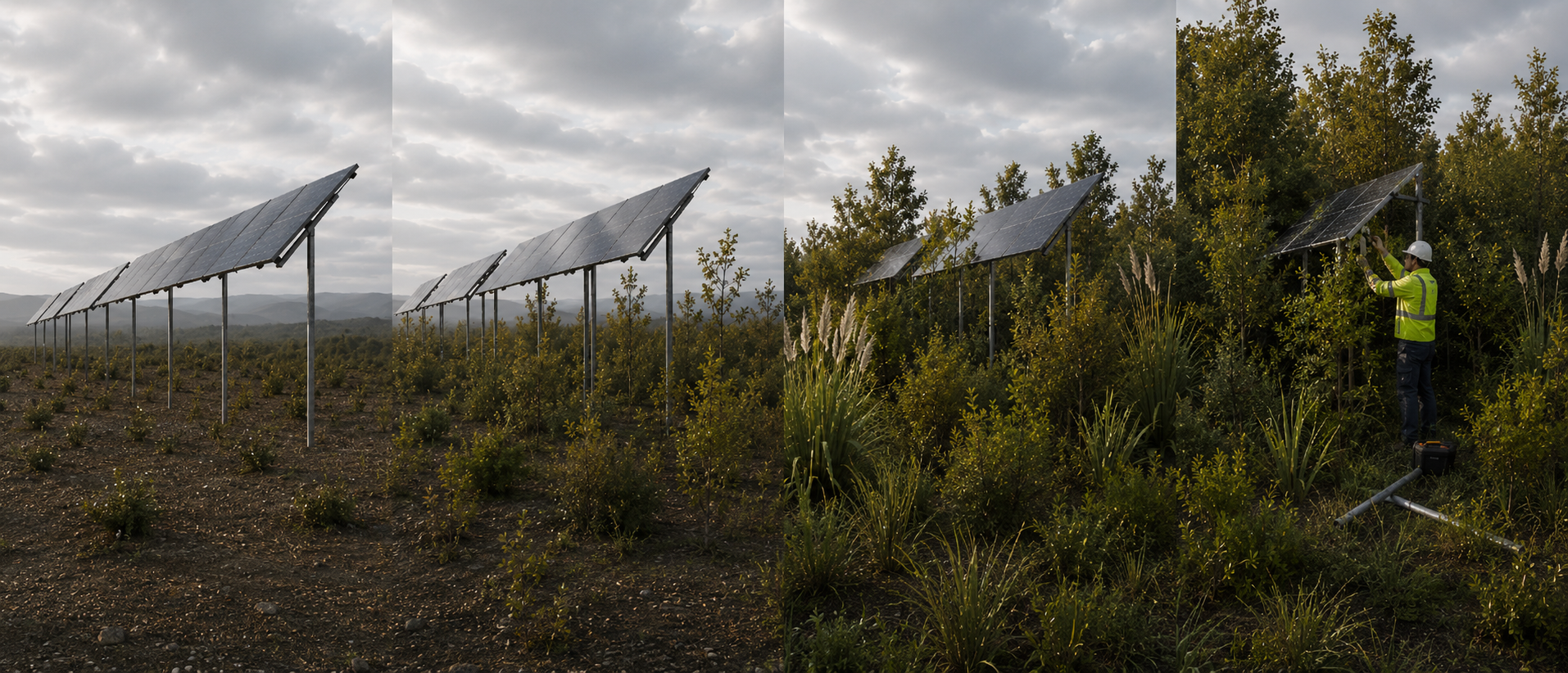
The project asks whether carefully designed solar infrastructure could act as a temporary nursery-species substitute - providing shade, shelter, moisture retention, monitoring access, and stewardship presence during the fragile early stages of native reforestation.
The project began with an observation that many natural systems rely on transitional structures. In regenerating forests, pioneer species create the conditions that allow more complex ecosystems to emerge.
Light Forest asks whether carefully designed solar infrastructure could perform a similar temporary role.
At the centre of the investigation is hydrology. Rather than imposing a design onto a landscape, Light Forest seeks to understand the patterns water naturally creates - from subtle drainage pathways and wetland formation to larger landscape-scale features.
The guiding principle is that infrastructure should align with these processes rather than override them.
The project explores how the regular presence required to maintain energy infrastructure might create unexpected conservation benefits. Monitoring, predator control, biodiversity surveys, native species establishment, and long-term ecological data collection all become easier when people are already present on the land.
An early-stage exploration of whether solar structures can provide shade, shelter, moisture retention, monitoring access, and stewardship presence while degraded land transitions toward native vegetation.
It is not a claim that solar panels automatically restore land, or that all solar farms are ecological infrastructure. The concept depends on hydrology, species selection, climate, land history, design, management, and long-term ecological monitoring.
Selected public documents, research papers, project references, and technical sources informing this project room.
Nordic agrivoltaics / greenhouse-integrated PV paper exploring adaptive LED lighting and cultivation in northern conditions.
Open source →Nordic field reference around a 48 kWp agrivoltaic system in Trondheim and early crop/microclimate effects.
Open source →Practical Dutch agrivoltaics facility studying crop growth, light, temperature, water use, and soil under and between panels.
Open source →Dutch programme studying solar parks, soil quality, and biodiversity outcomes.
Open source →Research project asking whether solar parks can support diverse vegetation, rich fauna, pollination, and natural pest control.
Open source →Dutch research across solar parks looking at soil health, soil life, vegetation, insects, birds, mammals, and biodiversity quality.
Open source →Research paper reporting that PV panels can modify soil-surface microhabitats and accelerate vegetation recovery in arid sandy areas.
Open source →Supporting paper/report discussing solar photovoltaic programmes and desert restoration contexts in China.
Open source →Plain-English reporting on solar arrays being used to reduce evaporation, moderate wind and shade conditions, and support desert-control planting.
Open source →This section provides compact page context for search systems, accessibility tools, and AI readers.
{
  "page_type": "ProjectPage",
  "project_name": "Light Forest",
  "status": "early ecological infrastructure concept",
  "summary": "Light Forest explores whether elevated solar arrays could act as temporary canopy or nursery-species substitutes to support native reforestation, hydrological alignment, biodiversity monitoring and renewable electricity generation.",
  "key_question": "Can a solar panel act as a nursery species substitute long enough to accelerate native reforestation?",
  "reference_categories": [
    "Agrivoltaics and horticulture",
    "Dutch solar and biodiversity",
    "China / dryland solar restoration"
  ]
}