Alato AR5 Acoustic Recorder
Current NZ frame-reference device for monitoring bats and birds, successor to DOC’s AR4 acoustic recorder.
Open source → Aperi Studio
Aperi Field
Hardware Concept build. Once time, location, and three-dimensional sound maps can be captured together, acoustic data can be post-processed into behavioural maps.
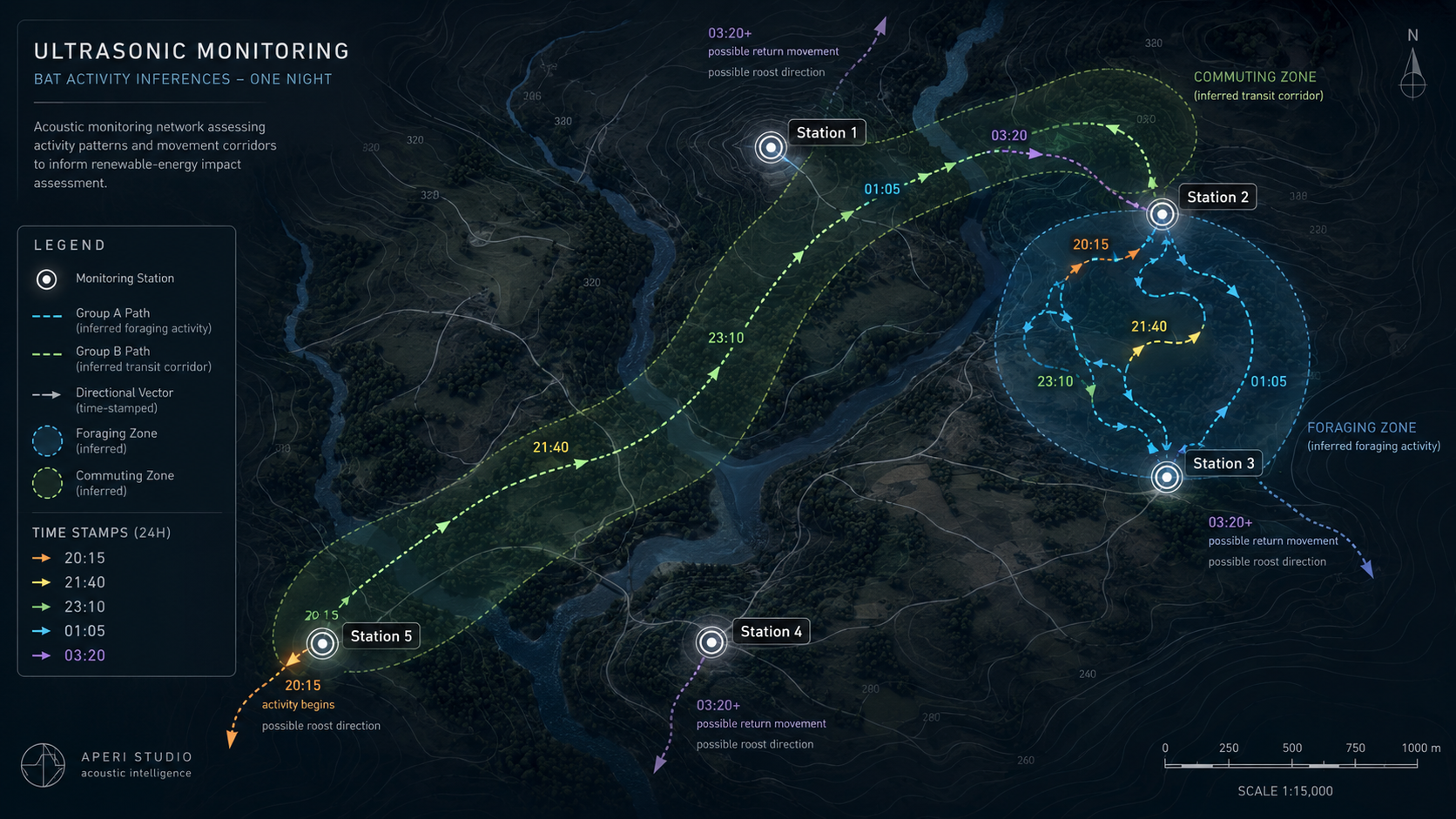
Aperi Field explores whether compact ultrasonic microphone arrays, GPS-linked logging, and AI-assisted analysis could help visualise bat population movement and possibly identify behavioural patterns in individual bats.
An early hardware and data concept for GPS-linked ultrasonic acoustic mapping, post-processed behavioural maps, and conservation monitoring around renewable-energy infrastructure.
It is not a validated field instrument or a replacement for established recorders such as the AR5. Any individual-bat or behavioural inference would require validation against known populations and field data.
The current hardware concept builds from:
Bat strike risk is one of the ecological concerns associated with wind-energy development. Better local acoustic monitoring could support site assessment, mitigation design, post-installation monitoring, and research into deterrent effectiveness.
Selected public documents, research papers, project references, and technical sources informing this project room.
Current NZ frame-reference device for monitoring bats and birds, successor to DOC’s AR4 acoustic recorder.
Open source →New Zealand monitoring guidance for bats using automatic bat detectors, including context around AR4/AR5 recorders.
Open source →New Zealand context document for bat risks and wind-farm development.
Open source →Research on fatality estimation around wind-energy facilities, including methods for accounting for carcasses outside searched areas.
Open source →Research on AI-assisted bat call classification, useful as a technical reference for acoustic post-processing and multi-species recordings.
Open source →Key southern Texas field study testing ultrasonic deterrents at an operational wind facility.
Open source →Accessible technical summary of the Weaver et al. southern Texas deterrent study.
Open source →Broader technical reference reviewing ultrasonic deterrents as a bat-mortality mitigation strategy.
Open source →Caveat source reporting mixed or negative results, useful for explaining why site-specific monitoring and behavioural mapping matter.
Open source →This section provides compact page context for search systems, accessibility tools, and AI readers.
{
  "page_type": "ProjectPage",
  "project_name": "Aperi Field",
  "status": "early hardware concept",
  "summary": "Aperi Field explores ultrasonic bat monitoring using MEMS microphone arrays, GPS-linked logging and post-processed three-dimensional sound maps for conservation monitoring and wind-energy impact assessment.",
  "hardware_pathway": "T5838 ×4 → PCMD3140 → ESP32-S3 → SD card",
  "reference_categories": [
    "Current reference device / New Zealand context",
    "Bat strikes, wind farms, and monitoring",
    "Ultrasonic deterrents"
  ]
}