Green ammonia and fertiliser sovereignty discussion document
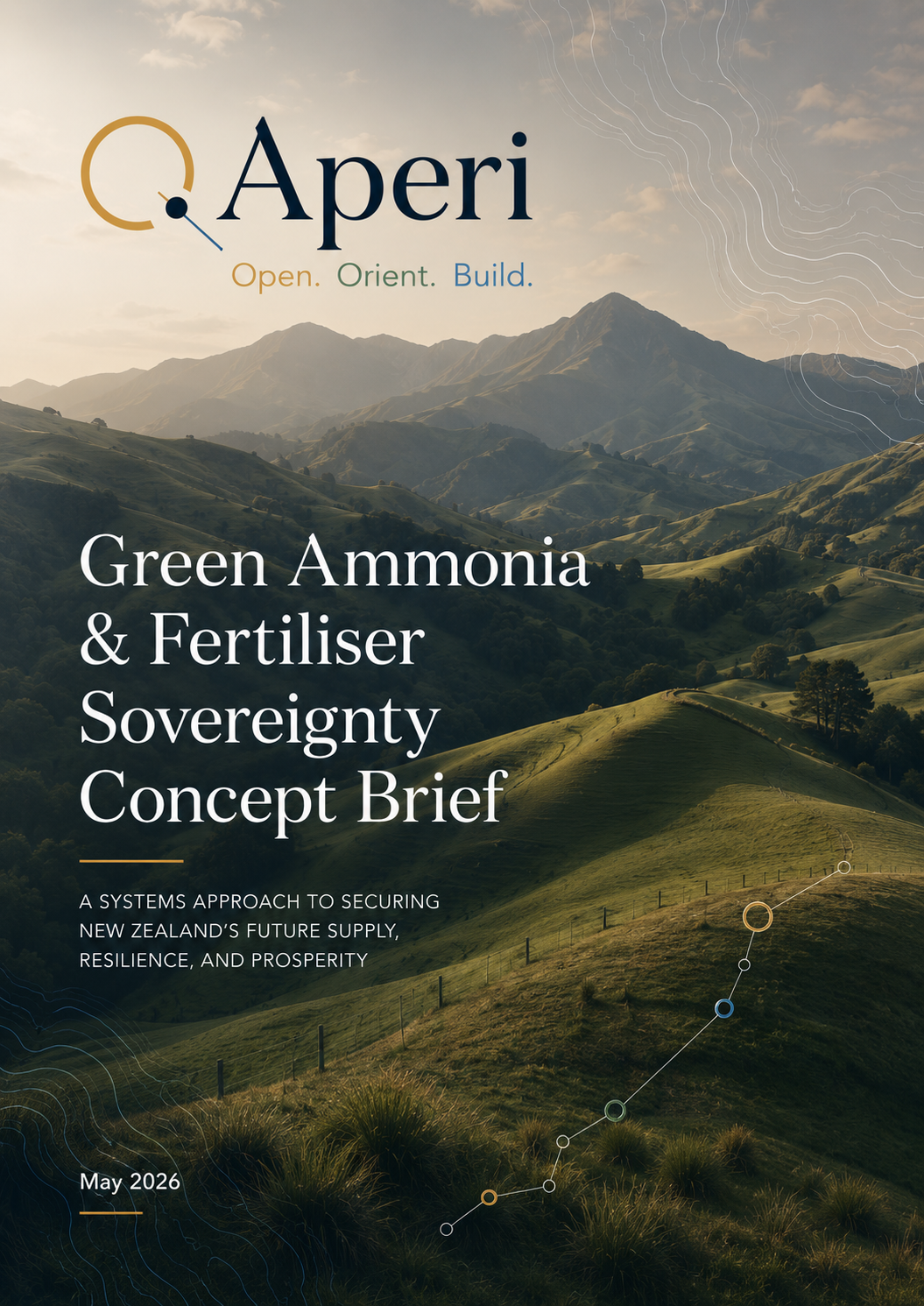
Aperi Studio’s public discussion document on nitrogen fertiliser resilience, renewable ammonia pathways, and New Zealand’s exposure to global supply risk.
Open source → Aperi Studio
Aperi Energy
Renewably produced electricity can be used to turn air, water, and limestone into a safe and ecologically sound replacement for urea, using decades-proven industrial technology.
The question is whether this can now be done in New Zealand in a way that is economically, environmentally, and regionally feasible.
Aperi Energy is researching that question through public-facing work on fertiliser sovereignty, renewable ammonia pathways, nitrogen supply risk, and regional resilience.
A public feasibility question about whether renewable electricity and proven chemistry can support production of a safe replacement for urea in New Zealand.
This is not a claim that green fertiliser is automatically cheaper than imported urea. It is also not the publication of selected applied concept work currently under private development.
A broader public discussion document on nitrogen fertiliser resilience, renewable ammonia pathways, and New Zealand's exposure to global supply risk.
Read the discussion document →Selected public documents, research papers, project references, and technical sources informing this project room.
Aperi Studio’s public discussion document on nitrogen fertiliser resilience, renewable ammonia pathways, and New Zealand’s exposure to global supply risk.
Open source →NZ-relevant reference linking renewable electricity, green hydrogen, and the Kapuni industrial/fertiliser context.
Open source →Project update describing renewable electricity for Ballance Kapuni site operations and hydrogen for emissions-free transport.
Open source →NZ large-scale green hydrogen/ammonia reference targeting renewable electrolysis and ammonia production for domestic and export assessment.
Open source →Large-scale China example with reported 320,000 tonnes per year green ammonia capacity in the first phase.
Open source →Commercial-scale Inner Mongolia renewable ammonia project reference, useful for understanding large-scale ammonia build-out.
Open source →Energy China-linked renewable ammonia project reference, useful for seeing green hydrogen and ammonia integration at industrial scale.
Open source →Market-formation reference showing how tenders, fertiliser offtake, and policy mechanisms can structure early green ammonia demand.
Open source →Government reference connecting green ammonia procurement incentives with fertiliser-sector demand.
Open source →Research paper modelling wind-to-ammonia system configuration, including generation, electrolysis, hydrogen storage, ammonia synthesis, transport, and grid options.
Open source →Research on green ammonia supply-chain development and market structure as the sector emerges.
Open source →This section provides compact page context for search systems, accessibility tools, and AI readers.
{
  "page_type": "ProjectPage",
  "project_name": "Aperi Energy",
  "status": "public discussion / feasibility research",
  "summary": "Public research track exploring whether renewable electricity and established industrial chemistry could support production of nitrate fertiliser from air, water and limestone in New Zealand.",
  "public_material": "https://scottjbarnett.github.io/nz-green-ammonia/",
  "commercial_sensitivity": "Selected applied concept work remains unpublished while under development.",
  "reference_categories": [
    "New Zealand references",
    "International scale references",
    "Market structure and research"
  ]
}